
Calhoun Projected Versus Actual Release
A projected release date is a forecast based on the sentence and data then in effect. An actual release date or timestamp records an event that happened. The two may differ. Discipline, earned credit, new court action, parole review, or another agency's hold can change the path.
A pretrial detainee at Calhoun County Jail has no sentence-expiration date merely because bond was set. Release may depend on bond, dismissal, or a court order. A county inmate serving a local sentence may have a calculation held by the jail. A prisoner at Calhoun State Prison belongs to GDC.
Find Calhoun Projected Release Dates
GDC's public search covers adult state correctional records. It is not a complete county-jail list.
- Search GDC by exact name and, if known, GDC ID or case number.
- Confirm identity through age, descriptors, offense, sentence county, and facility.
- Read the facility and custody status. A current GDC facility means state custody continues.
- Copy each label exactly, including projected release, maximum release, TPM, PIC, parole eligibility, or supervision.
- Check the Parole Board's TPM lookup and parolee search when relevant.
- Read the Calhoun court sentence, probation terms, and revocation entries.
- For someone held only at the county jail, ask the jail and court.
Begin at GDC Find an Offender. Use the Calhoun released-inmate search for a broader route.
Calhoun Earned-Time Release Rules
County-jail earned time and state parole are separate. O.C.G.A. 42-4-7 addresses county inmate records and earned-time allowances. A county inmate sentenced to confinement is released at sentence expiration less earned-time allowances. The statute creates no online Calhoun calendar. The jail or sentence record remains the source for the person's calculation.
O.C.G.A. 42-9-45 includes a general parole-consideration rule of one-third of the sentence or nine months, whichever is greater, subject to exceptions. Serious violent felonies, recidivist rules, life terms, and other limits may alter eligibility. Eligibility permits consideration. It does not promise release.
The Board explains that a Performance Incentive Credit date, or PIC date, may mark the maximum amount by which good conduct can advance a tentative parole month. Poor performance may postpone it. That is not county-jail earned time.
Why Calhoun Release Dates Move
| Factor | Possible effect |
|---|---|
| Earned credit | County earned time or parole credit may affect a forecast. |
| Discipline | Lost credit or poor performance can move a date later. |
| Parole action | The Board may set, postpone, cancel, or deny a plan. |
| Court order | Resentencing, credit correction, or revocation may change the term. |
| Detainer | Another agency may take custody at release. |
| Correction | Identity, sentence, or credit updates may alter the display. |
The Board may reconsider a prior decision up to release. A displayed month is not a firm day. Release from one agency can also be a transfer.
Confirm Calhoun Release Timing
For state custody, compare GDC with the Parole Board and DCS. For county custody, call the jail at (229) 849-2480 and read the sentencing or bond order. Georgia VINE may provide alerts where an agency supplies data. Register through VINELink Inmate Search, then confirm with the originating agency.
If the display is unclear, GDC accepts open-records requests through its portal. GDC states an initial response is due within three business days, nonmedical copies cost $0.10 per page, and search or redaction time may be billed. Ask for a specific public record and field.
Georgia Release Date Labels
O.C.G.A. 42-5-9 uses “projected release date” and requires GDC notice at least 15 days before scheduled release under department authority. Georgia Rules 125-2-4 defines “Maximum Release Date” as the date a person would leave GDC after serving the whole sentence without parole. No maximum date exists for life or death sentences.
The State Board uses “Tentative Parole Month,” or TPM. It is the month for final review and, if appropriate, later setting of a parole release date. It is not a final decision.
The projected-release notice statute displays the statutory term.
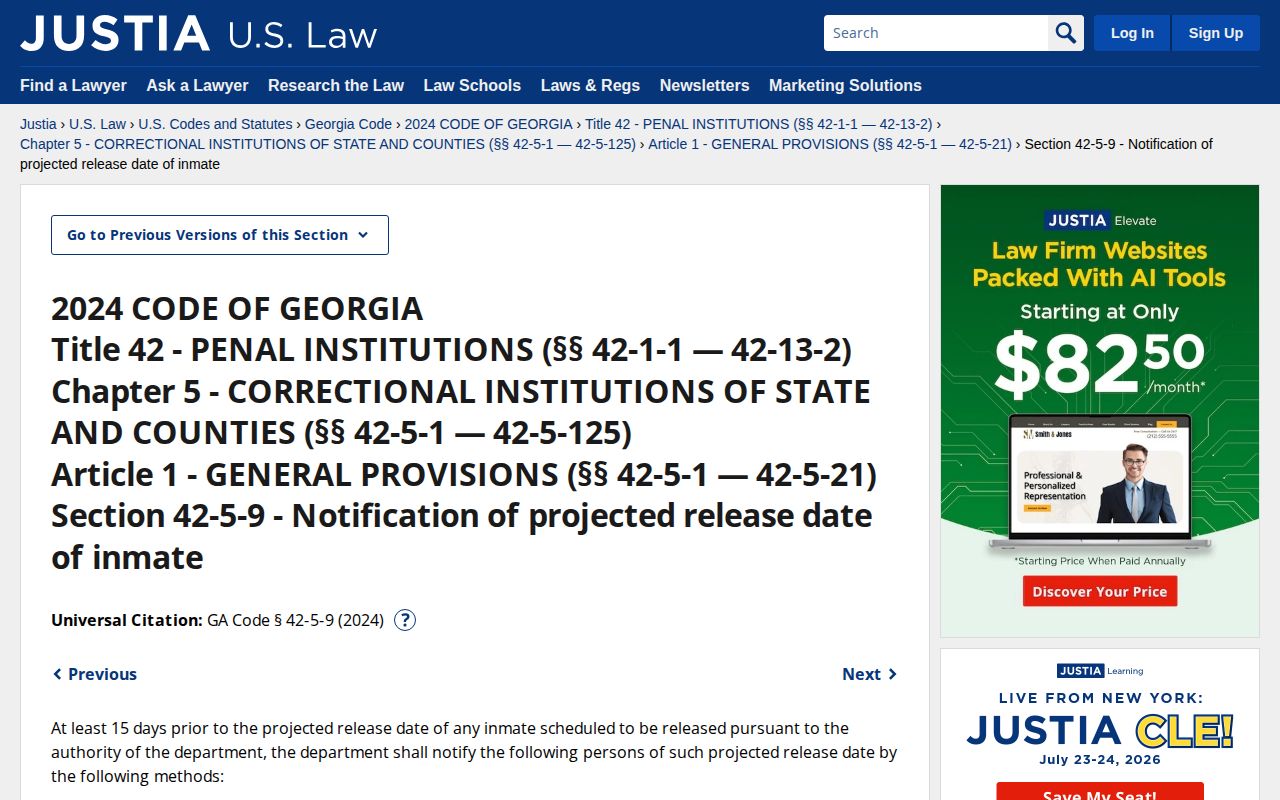
The statute concerns notice. It does not prove a planned date became an actual release.
Calhoun TPM Parole Review
The State Board TPM guide explains tentative parole months.
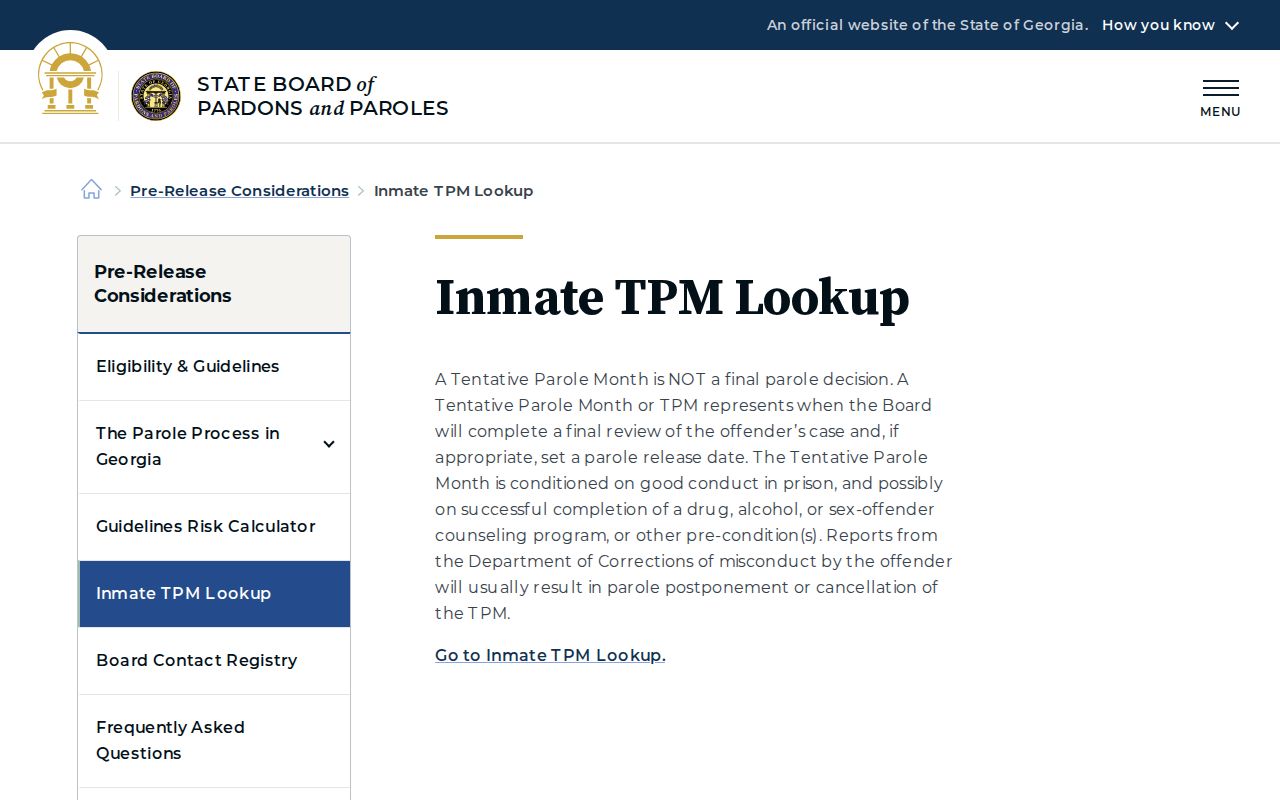
Use it for a state prisoner, not a pretrial county detainee. If parole is granted, DCS may supervise the person after release. A parolee record shows supervision, while GDC status addresses incarceration.
Monthly Board meetings are not offender-case hearings. Board material says individual cases are not discussed and parole decisions are not made there. A meeting notice is not proof that a person's date changed.
The Board may establish a future TPM or deny parole. Before release it can reconsider a prior action. Its guidelines describe TPM and PIC concepts, including performance effects. Keep that milestone separate from the maximum date calculated without parole.
Calhoun Jail and Prison Dates
Calhoun County has both a county jail and a state prison in Morgan. “Calhoun release date” is therefore ambiguous. The county jail holds local detainees and county inmates. Calhoun State Prison is a GDC institution. The same city creates different records.
For a pretrial detainee, focus on bond and court orders. For a county sentence, ask how O.C.G.A. 42-4-7 earned time was applied. For a GDC prisoner, use the offender search and state date labels. A person awaiting GDC transfer may appear first in local court records and later in state intake.
A county release timestamp proves local custody ended, not sentence completion or absence of another hold. A GDC projected date is forward-looking and does not prove an event occurred.
Request Calhoun Date Records
For GDC, use the open-records portal. Identify the person, GDC number, facility, sentence county, and exact field sought. GDC lists exceptions for institutional, investigative, security, medical, and personal information, so a narrow request may work better than a whole-file demand.
For county calculations, call the jail at (229) 849-2480 and sheriff at (229) 849-2555. Ask for the public sentence computation or release record. Contact the clerk at (229) 849-2715 for the sentencing order, docket, credit entries, and later correction or revocation orders.
If the records differ, ask which is current and whether the change reflects projection, correction, parole action, or another hold.
Read Calhoun Sentence Documents
A projected date begins with the controlling sentence. Request the sentencing order and docket from the Calhoun clerk. Look for the sentence length, confinement and probation portions, credit for time served, consecutive or concurrent terms, and later correction or revocation orders. Do not calculate a firm date from a charge list.
A split sentence combines confinement and probation. Release from physical custody can start the community portion rather than end the case. A revocation can return a person to custody or change the remaining term. A detainer can send the person to another agency when the present sentence ends. Each event may explain why an online date differs from a simple calendar calculation.
For a county inmate, the jail applies the local sentence and earned-time record under its authority. For a state prisoner, GDC and the Parole Board control their separate calculations and decisions. Keep the county record, GDC maximum or projected date, and parole TPM in separate notes.
Confirm an Actual Calhoun Release
After the projected day passes, check for an actual release or discharge entry. Ask whether the person left to the street, parole, probation, another jail, GDC, BOP, ICE, or another agency. A destination resolves whether physical custody ended or merely changed hands.
For Calhoun State Prison, compare GDC status with the parolee database and DCS. For Calhoun County Jail, call the jail and obtain the public release timestamp. If the release followed a court order, request that order from the clerk. Georgia VINE can add a near-term alert but should not replace these records.
When no public page resolves the conflict, submit a narrow open-records request. Identify the precise date label and ask whether it was projected, maximum, tentative, scheduled, or actual. The agency's own term is part of the answer.
Georgia Sentence Timing Exceptions
The general parole eligibility rule cannot be applied blindly. Georgia statutes and Board guidance contain exceptions for serious violent felonies, recidivist cases, life sentences, and other categories. Board guidance describes different initial consideration points for certain parole-eligible life sentences based on whether the serious violent felony occurred before July 1, 2006 or on and after that date.
Those consideration points do not create release guarantees. The Board can deny parole, establish a future TPM, or reconsider before release. For an individual case, use the sentence, offense date, Board status, and official eligibility guidance together. Legal interpretation belongs with qualified counsel or the issuing authority.
Read Georgia Parole Guidelines
The State Board's decision guidelines add context to a projected state-prison date. They describe a Tentative Parole Month and a Performance Incentive Credit date when parole is tentatively scheduled. The period between the PIC date and TPM is the maximum amount by which good conduct may advance the tentative month. Poor performance may add time without the same fixed limit.
These terms belong to Board decision-making. They do not alter the meaning of a county-jail earned-time record under O.C.G.A. 42-4-7, and they should not be applied to a pretrial detainee. For someone at Calhoun State Prison, compare the guidelines result with GDC custody, the sentence, and final Board action.
The Board may postpone or cancel a tentative decision before release. Consequently, the most recent agency record matters. Save the access date and exact label, then check again near the projected event and confirm the actual release through GDC.
Georgia Rules 125-2-4 also addresses felony prisoners held in county jails after conviction while awaiting transfer as directed by GDC. That interval can explain why a Calhoun court sentence exists before a normal state-prison record is visible. Ask the jail whether transfer is pending, then check GDC after intake. Do not label the local jail date as a state projected release date. Once GDC accepts custody, use the state record's own fields. If no maximum release date appears for a life sentence, that absence follows the rule's definition and should not be replaced with an estimated date.
Always preserve the access date for an online projection. A later display may reflect new credit, discipline, court action, or parole review, so two screenshots from different days are not necessarily the same agency calculation.