
BOP Federal Release Coverage
The official BOP Inmate Locator covers federal inmates incarcerated from 1982 to the present. Searchers can use a BOP register number or other federal identifier. A name search is also available. Exact identifying details matter because common names can return more than one person. The result should be matched by number, age, race, sex, and any other displayed facts before drawing a conclusion.
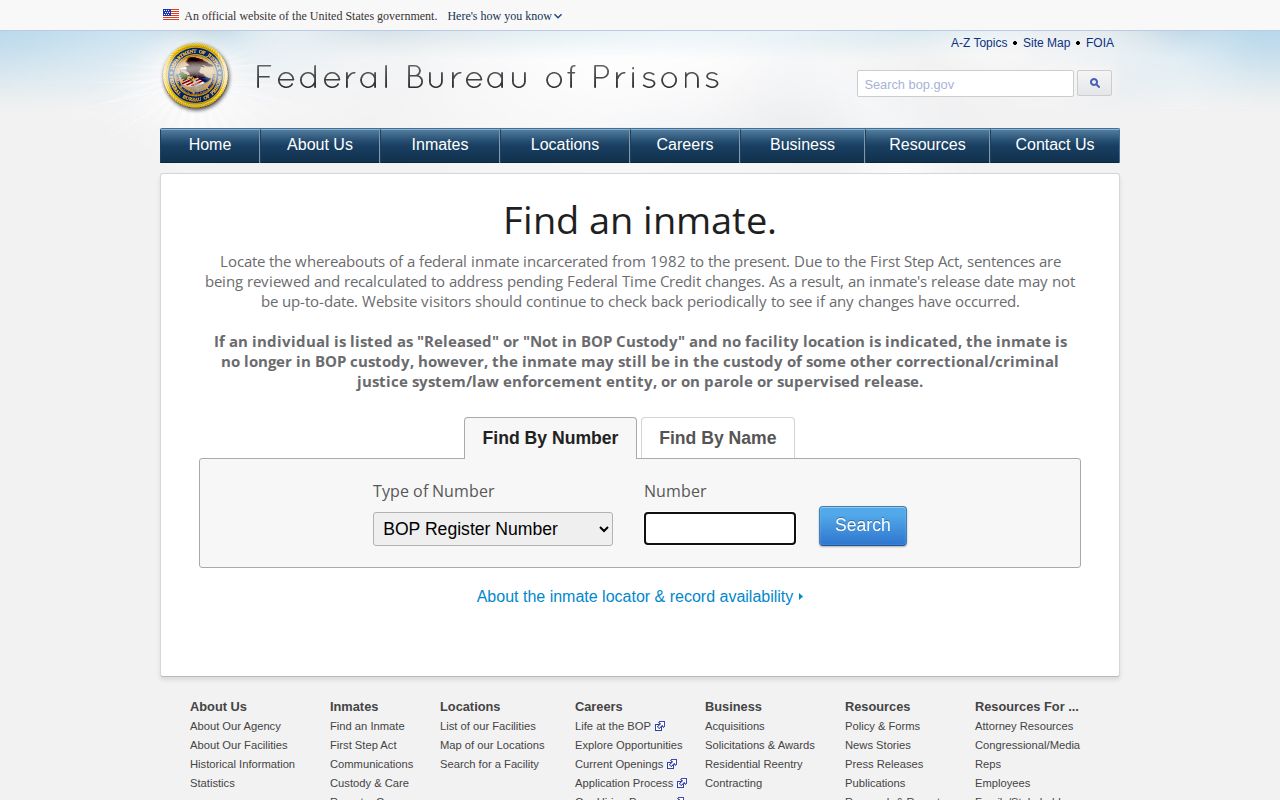
This route applies to a federal prisoner. It does not replace the Calhoun County Sheriff's Office path for a person booked at the Calhoun County Jail, and it does not replace the Georgia Department of Corrections Find an Offender search for someone sentenced to Calhoun State Prison. The Calhoun County released inmate guide separates those custody types. Starting with the arresting or sentencing authority prevents a blank federal result from being mistaken for proof of release.
Read a Federal Release Date
BOP explains that a past release date paired with no facility generally means the person left BOP custody on that date. The BOP inmate-record explanation also supplies the crucial limit: the person may remain on parole, supervised release, or in another correctional or criminal justice system. Supervised release is a court-ordered period in the community after imprisonment. It is not the same as continuing confinement.
A locator date should therefore be read as a BOP custody fact, not a broad declaration that all legal restraints ended. A release may be to the community, another jurisdiction, immigration custody, or another authorized setting. When the destination matters, compare the BOP entry with the federal court docket and the sentencing judgment. Those records can identify a supervised-release term or a later court action that the locator is not designed to explain.
Search Federal BOP Records
Open the locator and search first by a known federal number. BOP register numbers are the most direct key. The system also accepts identifiers associated with the District of Columbia Department of Corrections, Federal Bureau of Investigation, or former Immigration and Naturalization Service when available. If no number is known, search by the full legal name and narrow the result with the displayed identity fields.
- Confirm that the underlying custody was federal.
- Enter the federal identifier or the person's full name.
- Compare every identifying field before selecting a result.
- Read the current location or release-date field carefully.
- If the date has passed and no facility appears, consult BOP's record notes.
- Use federal court or supervision records when the next legal status matters.
Name variants, spelling, and older records can affect a search. BOP notes that records before 1982 may not be available in the online locator. For an older case or a disputed entry, the proper next step is a federal records channel, not a county roster.
Calhoun County Custody Boundaries
Calhoun County has a county jail and a major Georgia state prison in Morgan. Neither is a BOP institution. A person released from the county jail is normally confirmed through the sheriff, the jail, a release-record request, VINE when covered, or the Calhoun County Clerk of Superior Court. A person discharged from Calhoun State Prison belongs in the statewide GDC search and may also have a parole or Department of Community Supervision record.
A federal charge can still touch a local jail. The U.S. Marshals Service may arrange detention while a federal case is pending. After an initial federal hearing, the person may be released or remanded, meaning ordered into Marshal custody to await further proceedings. That stage can precede any BOP placement. A missing BOP record during a new case may mean the person has not entered the sentenced-prison system, not that the person is free.
Federal Transfers and Other Custody
Custody can change without a release to the street. A federal prisoner may complete a BOP term and then move to another agency because of a detainer, warrant, immigration matter, or state case. A detainer is a request that the holding agency notify or transfer the person rather than release the person unconditionally. The BOP date records the federal prison event. It may not state the full destination in a public result.
If ICE custody is possible, use the ICE Online Detainee Locator System. If Georgia custody follows, use GDC Find an Offender. A Calhoun County matter calls for the sheriff and court. Ask the releasing agency whether the disposition was community release or transfer when that information is publicly available. Moving through these systems in sequence is more reliable than treating one blank locator as a final answer.
U.S. Marshals Before BOP
Federal pretrial detention can precede a BOP inmate record. The U.S. Marshals Service explains that a person arrested under federal law must be brought before a magistrate judge or other judge for an initial hearing. After that hearing, the court may release the person or remand the person to Marshal custody to stand trial. If a conviction and prison sentence follow, the Marshals Service delivers the prisoner to the institution designated for the sentence. This sequence explains why the BOP locator may be the wrong first tool during a pending federal prosecution.
The Justice Detainee Information System, or JDIS, is described in the Marshals Service reading room as a database for records of prisoners in custody, people with federal warrants, and scheduled prisoner movements. It is not offered as a broad public detainee locator comparable to BOP's public search. Public access to Marshal detention details is therefore limited. For an individual pretrial case, the federal court docket, counsel, and authorized Marshal channels may supply context that a BOP search cannot.
Apply that distinction carefully in Calhoun County. A person held on a federal matter could be in Marshal custody without ever becoming a sentenced BOP prisoner. Conversely, a past BOP record can remain searchable long after the prison term ended. The custody stage determines the source: court and Marshals for pretrial detention, BOP for federal imprisonment, and the probation office or court judgment for supervised release after prison.
BOP Records and Contacts
The BOP locator is the main public starting point. For context about its fields and limits, use BOP's About Inmate Records page. BOP also publishes inmate release statistics. Those totals describe system activity and cannot confirm an individual's release. Individual questions must stay tied to the locator, the responsible institution, federal court records, or a proper federal records request.
Federal Bureau of Prisons
Inmate Locator: bop.gov/inmate_locator
Coverage: federal inmates, 1982 to present
Record context: bop.gov/inmateloc/about_records.jsp
No official source in the Calhoun research showed that the Calhoun County Jail operates a federal detention contract. The fact that federal detention can occur in local facilities does not support a claim about this jail. Verify the actual holding agency in the individual case.
Confirm the Federal Outcome
A BOP result answers a focused question: whether the identified person appears in the federal prison record and what location or release date BOP displays. It does not show that a criminal case was dismissed, that supervision ended, or that no other warrant exists. For a complete sequence, pair the locator with the sentencing court's docket and judgment. PACER is the federal judiciary's docket system, though access and fees may apply.
When personal knowledge is the goal, preserve the date and identifier used in the search. Then verify any unclear status with the originating federal office. If the person was only held before trial, U.S. Marshals and court records may be more useful than BOP. If the person served a Georgia sentence, use GDC. If the person left Calhoun County Jail, request the local release record. The correct agency is determined by custody, not by where the person lives.
What a BOP Result Cannot Prove
A current facility indicates BOP placement, but public information may lag an internal move. A past date with no facility supports release from BOP custody under BOP's own explanation, subject to its warning about supervision and other systems. No result may reflect a spelling problem, an older pre-1982 record, a pretrial detainee managed through another federal channel, or a person who was never in federal prison.
Keep the language narrow when sharing the result. “No longer shown in BOP custody” is more accurate than “completely free.” If a family member is arranging transportation or contact, confirm the destination through authorized channels before acting. Federal release information can change as agencies update records, and the originating office remains the best source for a disputed status.