
Calhoun Prison Release Paths
Calhoun State Prison is a Georgia Department of Corrections facility for adult male felons. Leaving this prison can mean parole to community supervision, discharge at the end of state custody, transfer to another GDC institution, movement to another authority, or release under a court-directed change. The facility location alone cannot identify which event occurred. Confirm the status in the statewide record and then follow the receiving system.
A parole release leads to oversight by the State Board of Pardons and Paroles and field supervision through the Georgia Department of Community Supervision. A maximum-release event can end GDC confinement without erasing other court obligations or another agency hold. A transfer keeps the person in custody. The Calhoun County release guide separates these outcomes and explains why the county jail roster is not the right source for a state prisoner.
Confirm Calhoun Prison Release
Start with GDC Find an Offender. Search by full name, GDC ID, or case number and use age or other identifiers to avoid a same-name match. Read the current facility or status, sentence data, and release information that appears on the individual record. Interface fields can vary, so do not infer a completed release from an absent field.
- Identify the GDC record. Match more than the name and note the current institution or status.
- Check parole decision status. Use the TPM lookup for an incarcerated person, remembering that a Tentative Parole Month is not final.
- Check post-release parole. Use the Parole Board parolee search after the person has left prison.
- Check DCS. The Cairo office serves Calhoun County when the released person is under felony supervision locally.
- Request GDC records. Use the department’s open-records portal when the public profile does not establish the actual release or transfer.
Calhoun Prison Records Contact
The official GDC facility page provides the physical address, telephone, fax, mailing address, population type, and visitation schedule.
Calhoun State Prison
Street: 27823 Main Street, Morgan, GA 39866
Phone: (229) 849-5000
Fax: (229) 849-5014
Mail: P.O. Box 249, Morgan, GA 39866
Visitation: 9:00 a.m. to 3:00 p.m. Saturdays, Sundays, and state holidays
The institution can route facility questions, but GDC’s central offender search and open-records process are the better routes for documented release data. GDC says open-record requests receive an initial response within three business days. Nonmedical copies are listed at ten cents per page, and qualified search or redaction time may be billed.
Calhoun Prison Record Fields
GDC offender records commonly show a name, GDC ID, physical descriptors, offense and case material, current facility or status, sentence facts, and a public photo when available. Individual records differ. A location indicates present state custody, while a release or discharge entry needs to be read alongside parole and supervision information. No current facility can be a useful clue, but it is not enough by itself to claim that every legal restraint ended.
A written request can seek public release, discharge, movement, or sentence information for a named person. GDC identifies exceptions that can cover institutional files, investigations, security-sensitive material, and medical or mental-health records without valid consent. Ask for a defined public record and date range instead of an explanation the agency would have to create.
Morgan Has Two Custody Systems
Calhoun State Prison and Calhoun County Jail are both in Morgan, but their records are not interchangeable. The prison is state-operated and holds sentenced adult male felons. The jail is a county facility for local custody. A person released on bond from the jail may never appear in the GDC offender search, while someone discharged from the prison should be traced through state records.
Confirm the street address when a caller says only “Calhoun.” Main Street points to the prison. North Bermuda Street points to the jail. This simple check prevents a county records request from being sent to GDC or a state discharge question from being sent to the sheriff.
Calhoun Prison Date Labels
Georgia uses several date terms. A projected release date is an administrative forecast and statutory notice point. O.C.G.A. 42-5-9 requires notice at least fifteen days before certain GDC releases. A Maximum Release Date, defined in Georgia Rules 125-2-4, is when the entire sentence would end without a parole decision. Life and death sentences do not have that maximum date under the rule.
A Tentative Parole Month belongs to the Parole Board process. The Board says it marks a final-review period and is not a final release decision. It may change before release. Use Projected Release for a fuller comparison, and use the completed GDC event or agency record to confirm that the person actually left custody.
Calhoun Prison Parole Follow-Up
The Parole Board decides parole. DCS supervises parolees and people on felony probation in the community. Before release, the TPM lookup can show decision status. After release, the parolee search is more relevant, and the Cairo DCS Field Office is the local field office serving Calhoun County.
Parole is conditional release before the full sentence ends. Discharge means the cited authority’s custody or supervision has ended, though another case or agency can still matter. When GDC shows release but a question remains about current supervision, check Probation & Parole and use DCS records rather than calling the county jail.
About Calhoun State Prison
GDC lists medium security, a capacity of 1,677, construction in 1993, opening in 1994, and renovation in 2008. The site has nine housing units, open dormitories, and segregation or isolation cells. These figures describe the institution and do not indicate the current population or a release count.
Programs include adult basic education, GED work, literacy support, re-entry, Thinking for a Change, Moral Reconation Therapy, Matrix programs, vocational and on-the-job roles, and faith or character programs. Program participation does not promise parole or a release date. It does show why release planning and post-release supervision can appear alongside the custody record.
Calhoun Prison Official Listing
The official GDC location page is the source for the facility’s address, phone, custody type, programs, and visitation details.
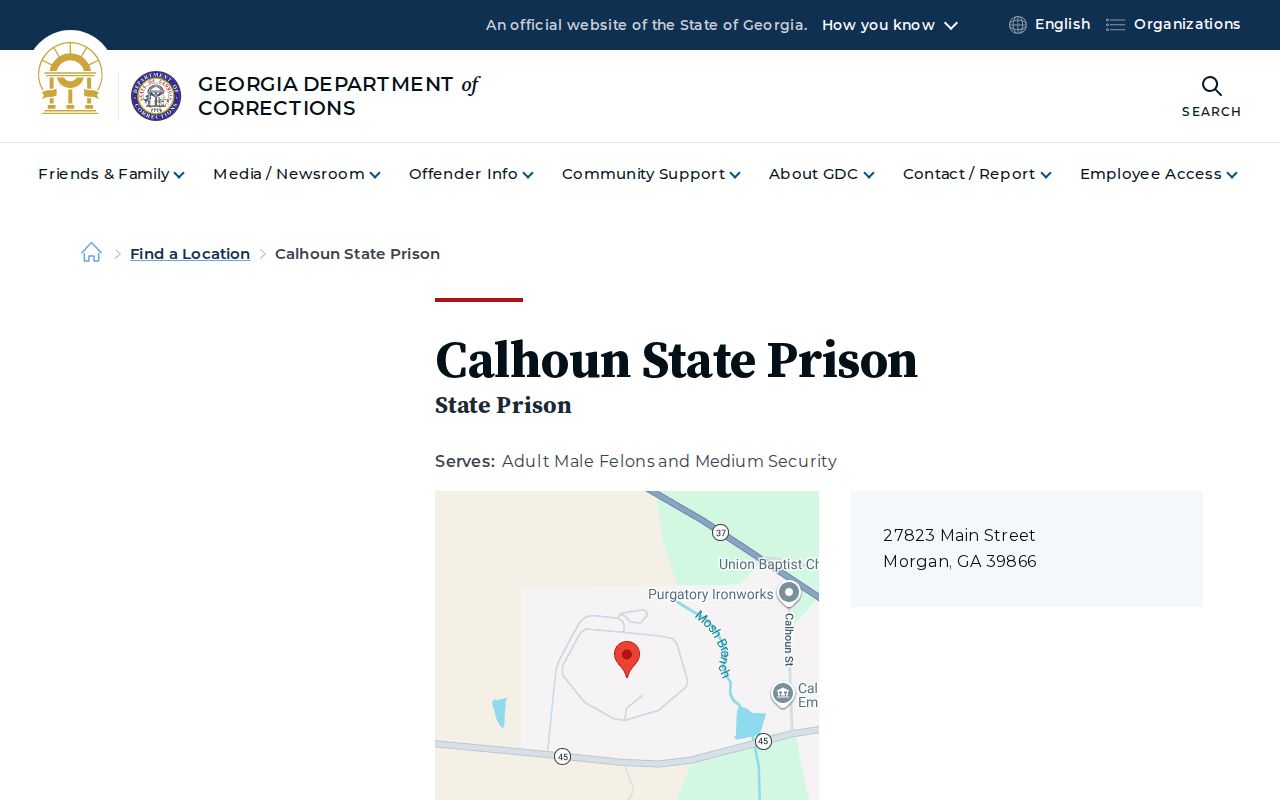
The page confirms the institution, while the person-specific offender search and GDC records process establish an individual release.
Calhoun Release Planning
Identification, transportation, and the correct supervision office may matter after release, but those practical steps do not alter the official date. Only the responsible state authority can confirm a completed GDC release. Record the source and check time because custody data can change. If another authority receives the person, continue with that agency rather than calling the transfer a release to the community.
Search GDC Release Details
GDC Find an Offender is the principal public route for a person who served a Georgia state sentence at Calhoun State Prison. Georgia.gov says adults in GDC facilities can be searched by name, ID or case number, age, and other identifying facts. It separately directs county-jail searches to county sources. That division matters in Morgan because the county jail and state prison are only different facilities in the same small city, not parts of one roster.
Public GDC records commonly include the name, GDC ID, physical descriptors, offense and case data, current facility or status, sentence information, and a photograph when available. Individual displays vary. Match more than a name, record the search date, and read the current facility field closely. A present institution means the person remains in GDC custody. An absent institution or release-related entry should be checked against parole, DCS, and GDC records before describing the person as fully discharged.
Calhoun Parole Decision Path
The State Board of Pardons and Paroles decides parole, while DCS supervises parolees in the community. For a person still incarcerated, the Board’s TPM lookup can show whether a Tentative Parole Month exists. A TPM is the month in which final review is expected and, if appropriate, a parole release date may be set. It is not a final decision. The Board may reconsider a prior decision before release, and misconduct can lead to postponement or cancellation.
After release, use the parolee search for public parole status. If the person resides in Calhoun County, the Cairo DCS Field Office is the local field office. It serves Baker, Calhoun, Decatur, Grady, Mitchell, and the South Georgia Circuit. Do not use the Board’s monthly open-meeting notices as an individual hearing calendar. The Board’s annual report says offender cases are not discussed and parole decisions are not made at those monthly meetings.
Request Calhoun Prison Records
Use the GDC open-records portal when the public offender profile does not establish whether an event was a release, discharge, or transfer. Identify the person, GDC number when known, relevant dates, and the existing public record sought. GDC lists a three-business-day initial response period, ten cents per page for nonmedical copies, and possible search or redaction charges based on the lowest-paid qualified employee’s hourly rate.
GDC also identifies exceptions that can apply to offender central-office and institutional files, investigations and intelligence, security-sensitive policies, employee information, and medical or mental-health material without proper consent. A focused request for public movement, release, discharge, or sentence information is easier to evaluate than a request for an entire institutional file. Keep the agency response with the live offender result and parole record so later status changes remain clear.